
Uncategorized

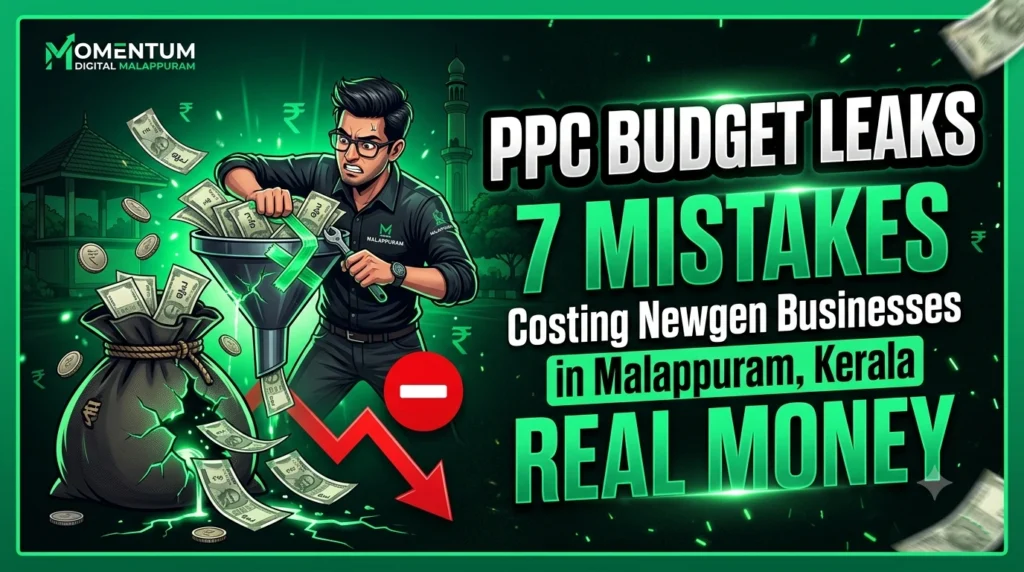
PPC Budget Leaks: 7 Mistakes Costing Newgen Businesses in Malappuram, Kerala Real Money

PPC Budget Leaks: 7 Mistakes Costing Newgen Businesses in Malappuram, Kerala Real Money By Muhammed Ishan As someone who works hands-on as a digital marketing strategist in Malappuram, Kerala, I’ve gone through the ad accounts of dozens of local newgen businesses — home bakers, small boutique owners, coaching institutes, and emerging D2C brands. One pattern keeps showing up: when a campaign underperforms, the platform itself is rarely the problem. Nine times out of ten, it’s a small set of avoidable habits silently chipping away at the budget without anyone noticing until the money’s already gone. Below are the seven I run into constantly, along with what actually fixes each one. Problem 1: The Ad Promises One Thing, the Landing Page Delivers Another This is, without question, the issue I find most often when I audit accounts for businesses in Malappuram. Picture this: a business runs a sharp, well-targeted ad — something like “20% off wedding sarees this Onam” — but every single click lands on a generic, cluttered homepage instead of a page built around that specific offer. The visitor now has to dig around trying to find what the ad actually promised. Most people won’t bother digging. They’ll just leave. The fix: Build a dedicated, focused page for every major campaign you run. Whatever the ad promises — a discount, a specific product, a limited-time deal — that exact thing should be the very first thing a visitor sees, with zero extra clicks needed to find it. Problem 2: Skipping Negative Keywords Entirely A lot of first-time advertisers in Malappuram set up a Google Ads campaign, pick a handful of broad keywords, and assume the algorithm will sort out relevance on its own. Without adding negative keywords, though, you’ll frequently end up paying for clicks that have nothing to do with what you’re actually selling. Take a tuition center bidding broadly on “tuition classes” with no exclusions in place — that campaign might start showing up for searches like “tuition classes jobs” or “free tuition classes,” neither of which brings in a single paying student. The fix: Pull up your search terms report weekly, especially during a campaign’s first month, and add anything irrelevant to your negative keyword list. This one habit alone tends to recover a surprising chunk of monthly ad spend. Problem 3: Changing Everything at Once and Learning Nothing It’s a common trap: performance dips for a week, and out of frustration, a business owner in Malappuram swaps the headline, the image, the audience, and the budget all in one go. When numbers shift afterward, there’s genuinely no way to tell which change actually made the difference. The fix: Adjust one variable at a time. Test a new headline this week; if you want to try a different image next, wait until the current version has gathered enough data first. It takes longer, sure, but it’s the only way your results actually tell you something useful going forward. Problem 4: Optimizing for Clicks When You Should Be Optimizing for Sales A high click-through rate looks great on a dashboard, but for a newgen business running on a tight budget, clicks by themselves don’t cover rent or restock inventory. I’ve reviewed Malappuram-based campaigns with strong click rates and barely any actual orders — the ad was pulling in curious scrollers, not real buyers. The fix: Before declaring any campaign a success or failure, put basic conversion tracking in place — a completed purchase, a submitted form, an inbound call. Clicks are just a signal along the way. Orders and genuine inquiries are the actual finish line. Problem 5: Pulling the Plug Too Soon This shows up constantly with first-time advertisers. A campaign launches, runs for two or three days without any dramatic wins, and gets shut down out of frustration — often just before the algorithm was about to gather enough data to start optimizing in your favor. The fix: Unless something is obviously broken — a dead link, wildly mismatched targeting — give any new campaign at least one to two weeks and a sensible daily budget before making a real judgment call. These platforms need time and volume to actually learn who’s converting. Problem 6: Setting It Up and Walking Away Even a genuinely well-built campaign needs ongoing attention. I’ve watched solid local campaigns in Malappuram gradually lose steam over a few months simply because nobody checked back in — costs quietly crept up, the same creative kept running long after people stopped responding to it, and a competitor’s fresh campaign started chipping away at the same audience. The fix: Build a simple habit of checking in weekly or every couple of weeks — even fifteen minutes spent reviewing cost, clicks, and conversions is enough to catch problems early. Problem 7: Copy-Pasting a Competitor’s Ad Strategy I see this a lot among newer business owners in Malappuram: a competitor’s ad seems to be doing well, so they recreate something visually similar and expect the same results. The issue is that an ad almost never succeeds in isolation — it’s usually working because of a specific audience, a particular offer, and a landing experience all built around one consistent message. Copy the surface-level creative without understanding what’s actually driving it, and the pieces simply won’t fit together the same way. The fix: Treat competitor ads as inspiration for tone and format, not a template to clone. Build your own offer, your own targeting, and your own landing page around what genuinely suits your business. One More Thing: Not All Clicks Are Worth the Same Here’s a mistake that’s easy to overlook: two clicks can cost the same amount but carry completely different value. A broad campaign in Malappuram might rack up plenty of cheap clicks from people who were never going to buy, while missing out on a smaller batch of pricier clicks from people who were genuinely ready to purchase. The fix: Stop measuring success by total click volume. Look instead at which specific


Uncategorized

Google Ads vs Meta Ads

Google Ads vs Meta Ads: Which One Should Newgen Businesses in Malappuram, Kerala Choose? By Muhammed Ishan This is easily the most common question I get asked as a digital marketing strategist working with newgen businesses across Malappuram, Kerala. A business owner has a little budget set aside for advertising, and they want to know: Google or Meta? Instagram or Search? The honest answer isn’t about which platform is “better” — it’s about understanding what your customer is doing at the exact moment you want to reach them. The Real Difference: Intent vs Interest I explain this to every client the same way, because once it clicks, everything else about platform choice becomes obvious. Google Ads targets intent. Someone in Malappuram is actively typing “best interior designer near me” or “online tuition for class 10 Malayalam medium.” They already know what they want. Your job is simply to show up at that exact moment with a relevant answer. Meta Ads (Facebook and Instagram) target interest. Someone is scrolling their feed, not actively searching for anything, but your ad interrupts that scroll because it matches something they care about — their interests, their location, their past behavior online. Neither platform is inherently superior. They solve two different problems in the customer’s decision journey. When Google Ads Makes More Sense For many newgen businesses in Malappuram, Google Ads works best when: The product or service is something people actively search for, like a plumber, driving school, clinic, or a specific course The business has local relevance, meaning it benefits strongly from Google Maps and Local Service Ads showing up when someone nearby searches You want higher-intent leads, people who are close to a decision rather than just browsing You’re comfortable with a somewhat higher cost-per-click, since you’re reaching people who’ve already shown clear intent A driving school in Kondotty, for example, benefits enormously from showing up when someone searches “driving school near me” — that person is often ready to enroll within days, not just casually browsing. When Meta Ads Makes More Sense Meta Ads tends to work better for newgen businesses in Malappuram when: The product is visual, like fashion, food, jewellery, or home decor — categories that dominate Kerala’s growing D2C and home-business scene You’re introducing something new that people wouldn’t think to search for yet, since they don’t know it exists You want to run retargeting campaigns toward people who visited your page or website but didn’t buy Your budget is limited, since Meta often delivers a lower cost-per-click for pure awareness and engagement goals A home baker in Manjeri launching a new dessert line is a perfect Meta Ads case — nobody is searching for that specific product yet, but a well-placed reel showing the product being made can stop someone mid-scroll and create genuine interest. Why This Choice Matters More for Newgen Businesses Specifically Established, well-funded businesses can often afford to run both platforms simultaneously without worrying too much about efficiency. Newgen businesses in Malappuram — home-based sellers, small service providers, first-time entrepreneurs — rarely have that luxury. Every rupee spent needs to justify itself. This is where understanding your customer’s actual behavior becomes critical before choosing a platform. I always start by asking a simple question with any new client: is your customer searching for you, or do they need to discover you? The honest answer to that single question usually settles the Google-versus-Meta debate before we even open an ads account. A Simple Way to Decide Here’s the framework I use with clients across Malappuram and Kerala when they’re stuck between the two: Do people already search for what you sell? If yes, lean toward Google Ads. Is your product something people discover visually, without prior searching? If yes, lean toward Meta Ads. Do you have an existing audience of website visitors or engaged followers you can retarget? If yes, Meta Ads retargeting is often the most cost-effective starting point. Is your business hyperlocal, like a clinic, gym, or repair service? Google’s Local Service Ads and Maps presence typically deliver stronger returns here. Why Most Growing Businesses Eventually Need Both While it’s smart to start with one platform to conserve budget and learn properly, most newgen businesses I work with in Malappuram eventually benefit from a combination: Meta Ads build initial awareness and introduce the brand to the right audience Google Ads capture people who are now actively searching for that brand or product by name Retargeting on either platform brings back people who showed interest but didn’t convert the first time Think of it as a funnel rather than a single decision. Meta plants the seed; Google often harvests the search that follows once someone becomes curious enough to look you up directly. A Local Example Consider a small clothing brand based in Perinthalmanna. They start with Meta Ads, showing reels of their new collection to women aged 20–35 in and around Malappuram district. A portion of the people who see those reels don’t buy immediately, but a few days later, they search “[brand name] Malappuram” on Google. If that business has a small Google Search campaign targeting branded terms, they capture that warm lead cheaply, right at the moment of highest intent. This combination consistently outperforms using either platform in isolation. What Happens When You Choose the Wrong Platform First I’ve seen this play out a few times with newgen businesses in Malappuram, and it’s worth mentioning honestly. A new skincare brand once came to me after spending several weeks running Google Ads for a product almost nobody was searching for by name yet. The clicks were expensive, and the results were disappointing, not because Google Ads is a weak platform, but because the audience simply wasn’t searching for that specific product category at that stage. Once we shifted the initial budget toward Meta Ads, using short video content to introduce the product visually to a relevant audience, engagement picked up considerably faster and at a noticeably lower cost per result. A

Uncategorized

PPC 101: What Paid Advertising Really Means for Newgen Businesses in Malappuram, Kerala

PPC 101: What Paid Advertising Really Means for Newgen Businesses in Malappuram, Kerala By Muhammed Ishan Every week, I meet a new business owner in Malappuram who’s heard the term “PPC” thrown around but isn’t quite sure what it means beyond “some kind of online ad.” That’s completely fair — most business owners here didn’t set out to become marketers. They set out to bake, stitch, teach, build, or sell something they believe in, and marketing became a requirement along the way. As a digital marketing strategist working closely with Kerala’s newgen business community, I think it’s worth slowing down and explaining PPC properly, in plain language, because understanding it changes how you spend your money. What PPC Actually Means PPC stands for Pay-Per-Click. The core idea is refreshingly simple: you only pay when someone actually clicks your ad. If a thousand people scroll past your ad on Instagram and only twenty click, you pay for those twenty clicks — not the thousand impressions. This is very different from traditional advertising, where a business in Malappuram might have paid a fixed amount for a local newspaper insert or a cable TV slot regardless of how many people actually acted on it. For a newgen business — say a home-based clothing brand in Tirur or a coaching institute in Kondotty — this shift matters enormously. You’re not gambling on a fixed cost anymore. You’re paying only for genuine interest. How the Auction Actually Works Here’s where most explanations get overly technical, so let me simplify it the way I do for my own clients. Every time someone in Malappuram searches “best bakery near me” on Google, or scrolls past a fashion reel on Instagram, an automatic auction happens behind the scenes in a fraction of a second. Several advertisers are competing for that exact same person’s attention. The platform then decides who wins that spot, based on two things: How much you’re willing to pay (your bid) How relevant and well-built your ad is (your Quality Score on Google, or Relevance Score on Meta) This second part is the one most local businesses underestimate. A bigger budget doesn’t automatically win. I’ve seen a small tuition center in Malappuram with a modest daily budget outperform a much bigger competitor simply because their ad copy and landing page were more relevant to what people were actually searching for. The platform rewards relevance, not just money. Why This Matters Specifically for Kerala’s Newgen Businesses Newgen businesses — the home bakers, D2C brands, tutoring centers, and small service providers popping up across Malappuram and the wider Kerala region — usually don’t have the luxury of large marketing budgets. Every rupee needs to work hard. This is exactly why understanding the mechanics of PPC isn’t optional homework; it’s the difference between a campaign that runs out of money in a week and one that builds steady, affordable customer acquisition over months. When I sit down with a new client here, the first thing we do isn’t picking a budget — it’s understanding intent. Are we trying to catch someone actively searching for a solution (which points toward Google Ads), or are we trying to introduce a new product to people who aren’t searching yet (which points toward Meta Ads)? That single decision shapes everything that follows. The Formats You’ll Actually Use For most newgen businesses I work with in Malappuram, three formats matter most in the beginning: Search Ads — text ads on Google that appear when someone searches a specific term, ideal for services people actively look for, like a driving school or a clinic Social Ads — image and video ads on Instagram and Facebook, ideal for visual products like clothing, food, or home decor Shopping Ads — product listings with images and prices, useful for anyone selling physical products online, including small D2C sellers shipping across Kerala Trying to run all three at once with a small budget usually spreads resources too thin. I typically recommend starting with just one, mastering it, and expanding from there. A Local Example of How This Plays Out Consider a small home bakery based in Manjeri that wants to grow beyond word-of-mouth orders. Running a PPC campaign doesn’t mean throwing money at “cake” as a keyword and hoping for the best. It means identifying that people nearby are searching for things like “birthday cake delivery Manjeri” or “custom cake order near me,” bidding on those specific phrases, and building a simple landing page that shows exactly what they’re looking for — pricing, delivery area, and real photos of past orders. That’s the practical reality of PPC for a newgen business here: small, specific, and measurable steps rather than big, vague campaigns. Common Misunderstandings I Encounter A few things come up again and again when I explain PPC to business owners in Malappuram: “I’ll just put in a big budget and results will follow.” Budget matters, but relevance and targeting matter more. A well-targeted ₹500 daily budget often outperforms a poorly targeted ₹2000 one. “More platforms means more customers.” Running ads everywhere at once, without enough budget to gather meaningful data on any single platform, usually leads to weak results across the board. “PPC gives instant, permanent results.” PPC gives you visibility exactly as long as you’re paying for it. It’s a powerful tool for immediate reach, but it works best alongside organic efforts like SEO and content, not as a total replacement for them. Why Local Context Changes the Approach Something that often gets missed by generic marketing advice: Malappuram’s audience behaves differently from a metro city audience. Buying decisions here are often influenced by community trust, festival timing like Eid and Onam, and a strong preference for businesses that feel personally connected to the buyer. A digital marketing strategist based in Kerala, working with local businesses day to day, understands these nuances in a way that generic templated campaigns simply can’t replicate. This local understanding directly shapes how ad copy is written, which keywords actually

Scroll to Top